Strengthening Climate Action through Learning and Community Engagement
Posted: 28 July 2026
Han May May Aung
Australia Awards Short Courses Alumna
Han May May Aung has built her career supporting community development and climate resilience through Monitoring and Evaluation (M&E) of development and humanitarian programs in Myanmar. In her current role, she works closely with communities whose livelihoods are increasingly affected by climate change.
Recognising the growing urgency of climate-related challenges and the need to strengthen her technical capacity, Han May undertook the Australia Awards Myanmar Short Course titled Responding to the Climate Change Challenge, delivered by the University of Queensland in 2024. The course provided an opportunity to deepen her understanding of climate change and gain practical skills directly applicable to her work.
Reflecting on her experience, Han May described that the program offered a dynamic learning experience that combined theory with real-world application.
“The course was a valuable experience for us. It provided not only theoretical knowledge and understanding on climate change issues, but also practical learning opportunities through field visits and real-life examples.”
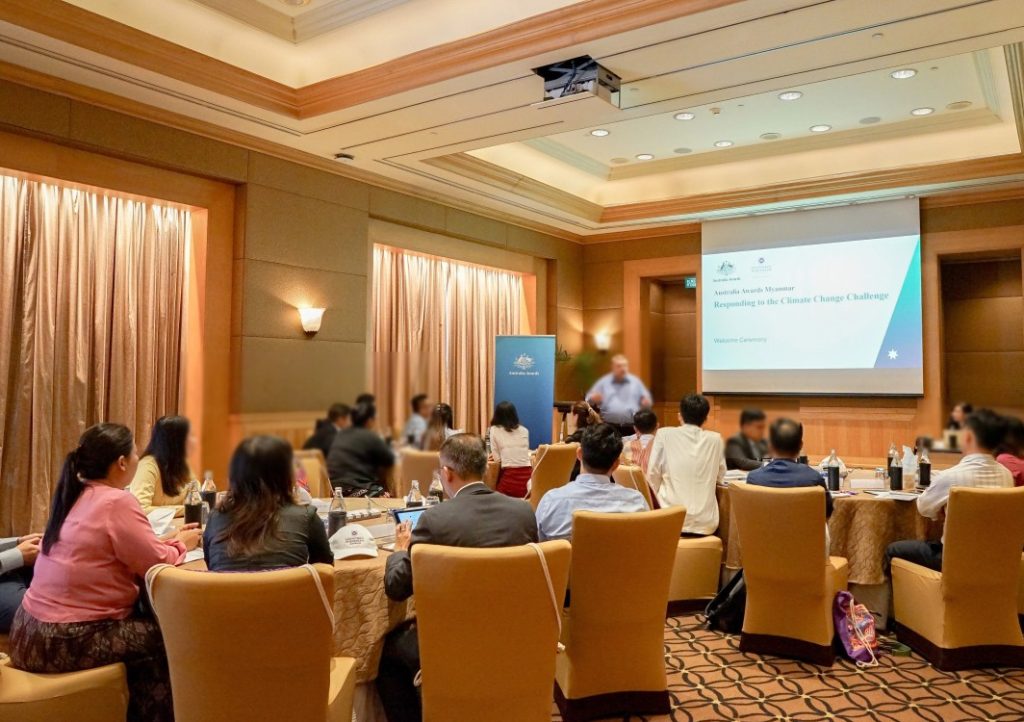
Han May (left, wearing a traditional pink dress) participated in the Australia Awards Myanmar Short Course delivered in 2024.
A key highlight of the course was exposure to practical climate solutions, including solar energy systems, Nature-Based Solutions (NBS) initiatives, and a carbon credit and emission reduction village. These field experiences enabled Han May to better understand how climate mitigation and adaptation approaches are implemented in practice, and how similar models could be adapted to local community contexts in Myanmar.
Equally important were the professional connections she built with participants from diverse sectors and organisations. These exchanges broadened her perspective, fostered collaboration, and strengthened a network of practitioners working on shared climate and development priorities.
Since completing the course, Han May has actively applied her learning to strengthen climate-responsive programming. She is now more confident in engaging with climate change issues, contributing to climate-related proposals, and integrating climate considerations into village-level monitoring systems.
A key priority for Han May has been ensuring that the knowledge gained extends beyond her individual learning. She has facilitated knowledge-sharing sessions with farmer groups, sharing practical tools and resources to support wider capacity building.
“I introduced climate-focused knowledge sharing with farmer groups, communities and promoted community discussions on Climate-smart Agriculture (CSA) and local weather observations tools to improve awareness of climate change.”
By introducing simple, accessible tools for communities to observe and record local weather patterns, Han May is helping them better understand climate trends and make more informed decisions about their livelihoods.
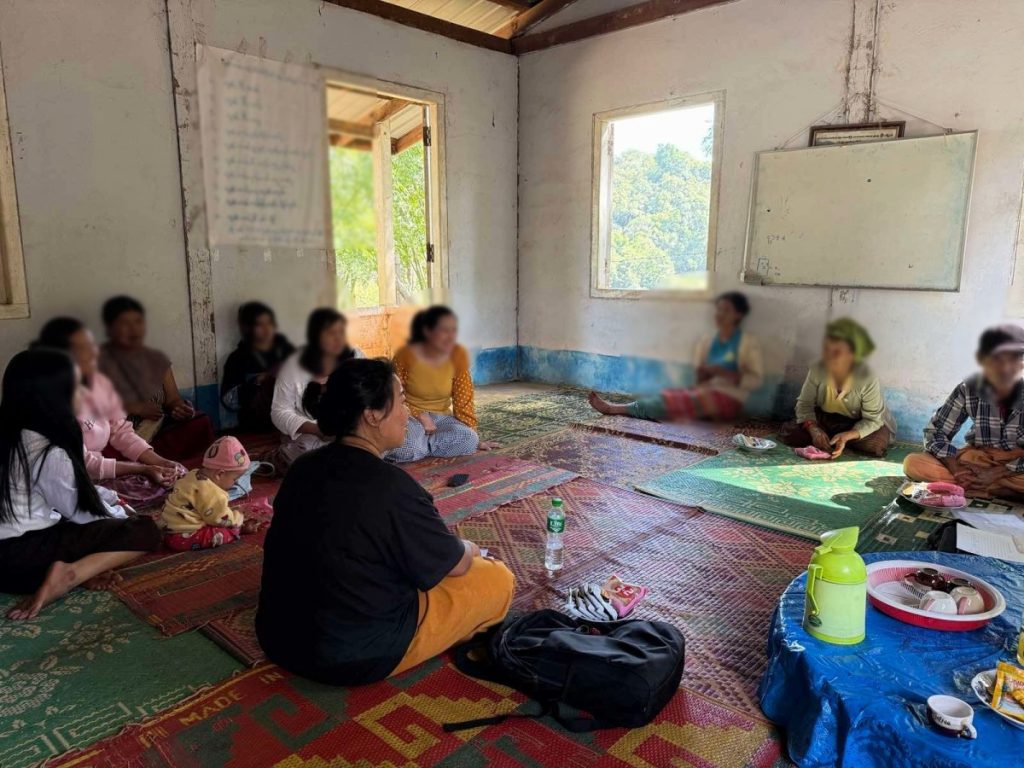
Han May interacted with farmers during her visit to the project areas.
These efforts have contributed to increased awareness of climate change at the community level and encouraged more proactive, locally-driven responses. While resource constraints remain a challenge, her work demonstrates how knowledge-sharing can lead to gradual but meaningful improvements in planning and resilience.
Han May remains actively connected to the professional relationships established during the course, maintaining strong connections with mentors and peers. Through this network, she exchanges practical insights and experiences related to NBS and other climate approaches with civil society organisations in Myanmar. These exchanges not only strengthen her own practice but also reinforce the critical role of collaboration in addressing complex climate challenges.
The Australia Awards Myanmar Short Course has been a significant milestone in Han May’s professional journey. By combining global learning with local application, she is contributing to stronger, more climate-resilient communities. Her experience highlights how targeted learning opportunities can empower development practitioners to translate knowledge into meaningful action on the ground.